top of page

BLUEPRINT 2030 BLOG

The Voice. The Vision. The Roadmap.

Blueprint 2030 is the digital heartbeat of Project 2030: The Agenda for Black America—where ideas become action and policy meets the people. Each week, our authors and contributors break down the six pillars of the Black Agenda with clarity, courage, and strategy.

From economic empowerment and educational equity to criminal justice reform and technological inclusion, Blueprint 2030 translates complex policy into practical steps every reader can take. This is where vision becomes measurable progress—where we track the work, celebrate the wins, and hold ourselves accountable to the promise of a stronger, freer, and more united Black America by 2030.

Because a vision without a blueprint is just a dream.

Health Justice

Tonight, I get to do something that still doesn't feel routine to me, no matter how many rooms I've stood in front of over the last three decades: I get to talk about Project 2030: The Agenda for Black America with a community that actually wants to build something with it.


The Joseph P. Bundy Book Club has been doing this work for a while now under a simple but powerful banner "Revitalizing Through Community Engagement." It's the kind of organization that reminds you why books matter in the first place. Not as decoration on a shelf. Not as a credential. As tools. As blueprints. As the start of a conversation that turns into action.


Sean T. Long Book Club Presentation

Tonight's session is centered on two chapters I care deeply about: "Nia: The Purpose" and "Historical Rhythms: The Compromise of 1877 and Project 2025." I chose those two on purpose. You can't talk honestly about where Black America needs to go without reckoning with where the deals were made that shaped where we've been. History doesn't just rhyme, it repeats itself in policy, in broken promises, in the quiet compromises that get made in rooms most of us are never invited into. Understanding 1877 is understanding 2025. And understanding both is the only way Project 2030means anything more than a title.


I wrote this book alongside people I deeply respect, Dr. Denise Smith, Rev.

Johnnie Sellers, Shara Morrow, Stephanie Yarborough, Gloria Cooper-Blue, and Anthony Caulsey-Jackson, with a Foreword from Clayton Harris III, because I didn't want this to be one voice pretending to have all the answers. I wanted it to be a blueprint, stitched together from people who've actually done the work in their own lanes: education, business, culture, policy, health and wellness, community organizing. That's the only kind of agenda that holds up.


It means something to see Project 2030 sitting in the Top Ten on Amazon's Best Sellers list for General Sociology on Race Relations. It's not lost on me that Project 2025 is still holding the #1 spot on that same list, that's the reality of the landscape we're writing into, and it's exactly why this book needed to exist in the first place. We're not just responding, we're offering our own agenda.


Join the presentation today at 5pm CST/6pm EST via Zoom:

Website: www.zoom.us Meeting ID: 832 5971 8193

Passcode: 701710


Hello everyone, I know it has been a while. Today, I would like to welcome the over 7,000 new members who have joined us on this blog. We are glad you are here, and we want you to feel like this is your space. Bring your ideas. Bring your energy. Bring your questions. We are building something together, and the strength of these communities across the country depends on the people willing to show up and contribute.


Why Project 2030 Exists

Project 2030: The Agenda for Black America was born out of an idealistic view, but an idealism grounded in action. It is a roadmap for how we make the Black community stronger across six interconnected areas: education, health, wealth, political power, technology, and criminal justice reform. Its central focus, though, is you. It was written with you in mind, and with a simple question at its core: how can you make a difference on the block you live on, in the schools your kids attend, with the local businesses you can directly support, and with the politicians and policies you have the power to influence?


Let's break down what strength looks like in each of these six areas.


Education

A strong community starts with schools that prepare children not just to compete, but to lead. That means classrooms where AI and emerging technology are not just something students learn to use, but something they learn to build, and eventually own. Imagine a high school coding elective that ends with students holding equity in an app they built together, or a partnership between a local school and a tech incubator that gives students real ownership stakes in what they create. That is the kind of educational model that changes generational trajectories, not just test scores.


Health

Our neighborhoods should reflect the health of our community, not the neglect of it. There should not be more dialysis centers than urgent care offices. There should not be more liquor stores than grocery stores with fresh produce. Strengthening health means pushing for walkable neighborhoods, community health screenings, mental health resources that are actually accessible, and local advocacy that holds providers and city planners accountable for what gets built, and what doesn't, in our zip codes.


Wealth

Wealth building starts with ownership. Black entrepreneurship should be thriving, not surviving. That means supporting Black owned businesses with your dollars, mentoring a young entrepreneur instead of just following them online, and pushing for policies that make small business lending and capital more accessible. There should not be more liquor stores than banks in our neighborhoods. When we say wealth, we mean equity, ownership, and the ability to pass something down.

Political Power

Local politics shapes daily life more than most people realize, from school board decisions to zoning laws to who gets a small business grant. Political strength means showing up to city council meetings, knowing your alderman or commissioner by name, and organizing around the policies that affect your block specifically, not just the headlines. You do not need to run for office to have influence. You need to show up consistently and hold people accountable.


Criminal Justice Reform

A community cannot build wealth, health, or political power while its people are being pulled into a system designed to extract rather than rehabilitate. Criminal justice reform means pushing for fair sentencing, bail reform, and real reentry programs that give returning citizens a genuine shot at employment and housing instead of a lifetime of closed doors. It means supporting local organizations that offer legal aid and expungement clinics, showing up for school board conversations about the school to prison pipeline, and holding local law enforcement and prosecutors accountable through the same civic engagement we bring to any other policy fight. Strength here looks like fewer of our young people funneled into the system in the first place, and real pathways back for those who have already been through it.


Technology

This is where I talk in the book about how we are living on "digital plantations." We are creators of a massive share of the viral digital content online, the trends, the culture, the engagement that platforms are built on, but we do not own any of the platforms we are posting on, and we receive almost nothing in return for that labor. Technological strength means teaching our young people not just to consume and create content, but to build and own the platforms, the code, and the intellectual property. Ownership is the difference between contributing to someone else's wealth and building your own.


This Is Not a Coffee Table Book

Project 2030: The Agenda for Black America is not something you read once and set on a shelf. It is a living, breathing document meant to be used, to empower you, your neighbors, and your community, over and over again, as the work evolves.


Join the Conversation

On Wednesday, August 19 at 6:00 PM EST, Project 2030 is the topic of discussion for the Bundy Book Club. where Rev. Roi Johnson will lead this week's important opening session.

Rev. Roi Johnson will lead the book club discussion

Wednesday, August 19th at 6pm ETSTJOIN ZOOM MEETING

MEETING ID: 832 5971 8193

PASSCODE: 701710


Invite some friends, bend some pages, and join the discussion on how we make the Black community better, with 2030 as our mile marker for progress.


See you there.

-Sean T. Long

Author


Project 2030: The Agenda For Black America vs. Project 2025

Let me be clear — we are at a crossroads that will define the next century of Black life in America. The choices we make today will determine whether we move toward a nation rooted in equity, or one that allows decades of progress in civil and human rights to quietly unravel. This isn’t alarmism; it’s reality. The ground beneath us is shifting — politically, economically, and culturally — and the decisions we make right now will decide whether we continue to advance the unfinished work of justice or surrender it to the forces of regression.


Let me walk you through what's at stake—and more importantly, what you can do about it.

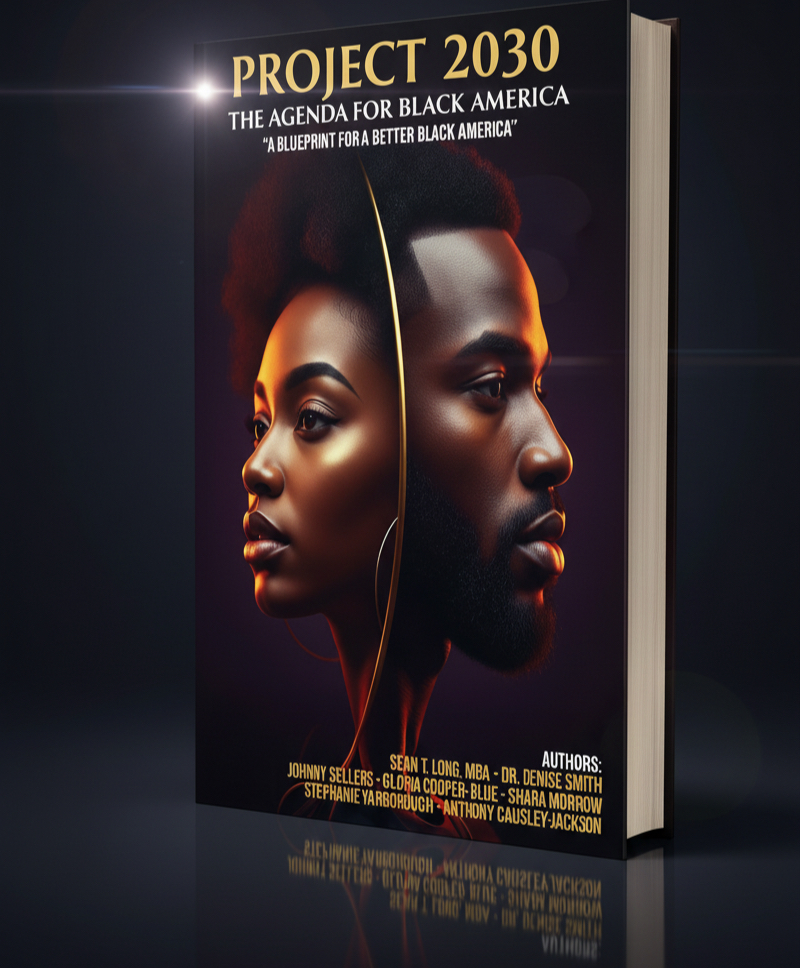
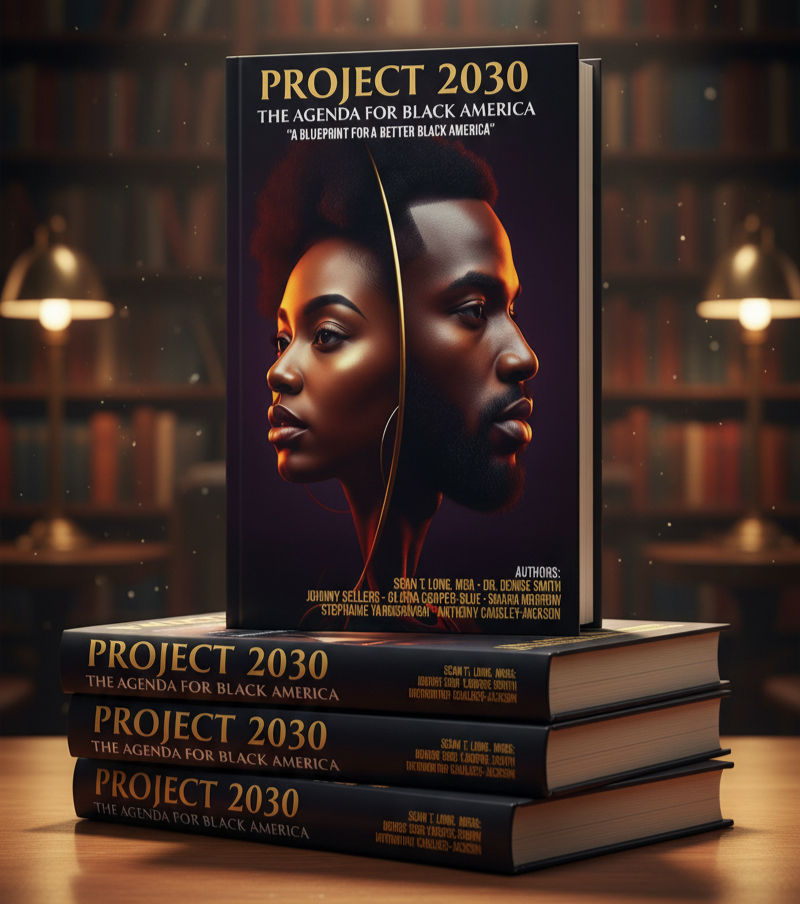
Books titled "Project 2030: The Agenda for Black America" stack on a library table, glowing lights above. Cover shows two faces.

Project 2030: A Blueprint We Can Actually Build With

When Sean T. Long and his team of visionary co-authors created Project 2030: The Agenda for Black America, they gave us something we desperately needed—a comprehensive roadmap forward at a time when the racial wealth gap keeps widening and our fundamental rights feel increasingly under attack.


Here's what struck me most about this work: Sean T. Long frames it perfectly when he says, "This is not just an agenda for Black America; it is a covenant for the nation." That's powerful. Because when Black America thrives, when our systems become more just, everyone gains access to genuine opportunity.

The Six Pillars That Could Change Everything


Project 2030 is built on six interconnected pillars—Economic Empowerment, Educational Equity, Health Justice, Criminal Justice Reform, Political Empowerment, and Technological Equity. But this isn't just academic theory. Each pillar provides actionable strategies that blend historical understanding with policy recommendations and lived experience.


Let me break down what this means for you:

  1. Economic Empowerment tackles the systemic barriers that have kept your family, my family, Black families everywhere from building generational wealth. We're talking about concrete solutions to close the wealth gap.

  2. Educational Equity addresses the disparities that start in kindergarten and compound all the way through college—the ones that make it harder for our kids to succeed no matter how brilliant they are.

  3. Health Justice confronts the ugly truth that we face worse health outcomes across nearly every medical condition. This pillar demands better.

  4. Criminal Justice Reform aims to end the mass incarceration pipeline that's been devastating our communities for generations.

  5. Political Empowerment ensures our voices have genuine power in shaping policy—not just symbolic representation, but real power.

  6. Technological Equity recognizes that the digital divide is the new civil rights frontier, and we can't afford to be left behind.


Project 2030 provides strategies to move Black America from survival to power, insisting that progress must be built everywhere Black people live, learn, and lead—from grassroots organizing to national policy.


Project 2025: The Threat You Need to Understand Right Now

Now let me tell you about Project 2025, because if you're among the 46 percent of Black Americans who've heard only a little or nothing about it, your lack of knowledge could hurt you and everyone you love.


Project 2025 is a 900+ page manifesto created by the Heritage Foundation with input from over 200 Trump-connected policymakers. This isn't a conspiracy theory I'm sharing with you—it's a publicly available policy agenda that civil rights organizations have analyzed and found deeply alarming.


Seven Ways Project 2025 Targets Us


Let me be direct about how this threatens our communities:

  • Civil Rights Rollbacks: Project 2025 calls for the elimination of affirmative action and diversity considerations across all federal agencies, directly undermining efforts to level the playing field for Black professionals and students. Think about your cousin who got her federal job through a diversity initiative. Think about your nephew applying to college. Think about all the black-owned firms that were able to get ahead because of diversity programs with the government. This affects them directly.

  • Educational Attacks: Project 2025 advocates for rolling back the Biden administration's student debt relief efforts, which have eliminated approximately $138 billion in debt—relief that disproportionately benefits Black borrowers who carry higher debt loads because of the racial wealth gap. If you're struggling with student loans, this policy would make your burden even heavier.

  • Voting Rights Suppression: Project 2025 also calls for a coordinated effort to weaken the political power of Black and Brown communities. From gerrymandered districts that dilute our votes, to stricter voter ID laws and voter registration purges targeting neighborhoods of color, these measures are quietly undoing decades of civil rights progress. In Georgia, SB 189 now makes it easier for partisan groups to challenge a voter’s eligibility, opening the door to mass challenges that could wrongfully remove thousands from the rolls. At the same time, laws that criminalize election assistance and limit absentee and mail-in voting are designed to suppress participation—especially among working-class families, seniors, and young voters. Even more alarming, proposals like adding a citizenship question to the U.S. Census would discourage many from participating, resulting in an undercount that robs our communities of fair representation and billions in federal funding for schools, healthcare, and infrastructure over the next decade.

  • Economic Devastation: Project 2025 proposes limiting overtime benefits for hourly and service workers, a group that includes 21% of Black Americans who rely on such jobs to make ends meet. It would also end funding guaranteed by the Small Business Administration, which fosters Black entrepreneurship and economic mobility.

  • Educational Dismantling: The plan advocates for the dismantling of the Department of Education and the withdrawal of federal support for low-income students, many of whom are Black.

  • Healthcare Rollbacks: Project 2025 aims to repeal the Affordable Care Act, reduce Medicaid funding, and eliminate programs aimed at addressing health disparities, which would lead to reduced access to healthcare services and worsening health outcomes for African Americans. This is what the current government shutdown is all about.

  • Executive Overreach: Under Project 2025's agenda, a future president could consolidate executive powers to have unilateral control over all federal decision-making, with little regard for the laws passed by Congress or the Supreme Court's decisions. This concentration of power threatens the very system of checks and balances that protects minority rights.


Here's What's Really at Risk—And Why You Should Care

The Legal Defense Fund didn't mince words: "Project 2025 will turn civil rights enforcement on its head by targeting programs designed to increase equal opportunity."

I need you to think about what this means for your life — not in theory, but in practice:

  • Your job, if you work in a federal agency or benefit from workplace equity programs.

  • Your ability to have discrimination complaints investigated fairly and without bias.

  • Your community’s political power and funding, determined by census data and fair redistricting.

  • Your student debt relief and the future affordability of college for working families.

  • The DEI programs that opened doors for you, your children, or your colleagues.

  • Your employment discrimination protections, including safeguards against bias in hiring, promotion, and pay.

  • Your right to vote, and the ease—or difficulty—of exercising it.

  • Your child’s ability to go to college, with access to scholarships, grants, and culturally responsive education.

  • Your access to affordable healthcare, including Medicaid expansion and reproductive rights.

  • Your small business opportunities, tied to minority business development programs that could be eliminated.

  • Your local schools’ resources, dependent on fair funding formulas and equity-based federal aid.

  • Your access to fair housing, as enforcement against redlining and housing discrimination faces rollback.

  • Your representation at every level of government, from city hall to Congress, shaped by who’s counted—and who’s left out.

Every. Single. One. Is under attack.


Smiling person holding "Project 2030" book on a tree-lined street with brownstone buildings, under a sunny sky.

Two Paths: You Get to Choose


Project 2030 gives us a covenant—a promise that when we build systems that work for Black America, we strengthen democracy for everyone. It's a roadmap from survival to power.


Project 2025 seeks to return us to a time when civil rights protections were weak or nonexistent, when discrimination was openly practiced, when the playing field was permanently tilted against us.


As one analyst put it, we can't just plan for next week or next year—we need to plan and strategize and organize and fundraise and work and build with the next 100 years in mind.


Your Call to Action: This Moment Demands Everything


Here's what I'm asking you to do—what I'm demanding you to do—because this moment requires more than passive concern:

1. Educate Yourself Fully—Today

Read the analyses from the Legal Defense Fund, NAACP, and Thurgood Marshall Institute. Don't rely on social media soundbites. Dig into the actual policy proposals. What you don't know will absolutely hurt you.

2. Have Those Uncomfortable Conversations

Talk to your family members who dismiss Project 2025 as "just politics." Share concrete examples of how these policies would affect their lives. Tell your uncle what it could mean for his federal job if diversity and inclusion initiatives are dismantled. Explain to your daughter that her student loans and debt relief could vanish overnight, pushing her dreams further out of reach. Remind your mother that her healthcare coverage, the medication she depends on, or her right to make personal medical choices could all be on the chopping block. Talk to your cousin trying to start a business — and how the minority business development programs that give him a fair shot might be eliminated. Show your neighbor how changes to the census could erase your entire block from political representation and drain your community of millions in funding for schools, housing, and infrastructure. Tell your pastor or your friend who votes every election that stricter ID laws and voter purges could silence their voice before it’s even heard. And if your kids think none of this touches them, tell them about the future — about what happens when the DEI programs, scholarships, and protections that opened doors for you no longer exist for them.

3. Get Project 2030 and Use It

Purchase the Prject 2030: The Agenda For Black America. Study its recommendations. Implement its strategies in your sphere of influence. Whether you're a teacher, business owner, community organizer, or concerned citizen, Project 2030 offers concrete actions you can take right now. Share it with everyone you know.

4. Organize Your Community

Host discussion groups. Invite speakers. Create action committees. The civil rights movement wasn't won through individual action alone—it required collective power. Start building that power in your community this week.

5. Contact Your Representatives—Be Relentless

Make your voice heard at every level of government. Demand they oppose Project 2025 and support Project 2030's principles. Be specific about what you want. Be persistent. Be unrelenting. Don't accept generic responses.

6. Vote Like Your Rights Depend On It—Because They Do

Research every candidate's position on civil rights, DEI programs, voting rights, and education equity. Vote in every election—local school boards matter, state legislatures matter, Congress matters. Show up every single time.

7. Support Civil Rights Organizations Financially

The Legal Defense Fund, NAACP, Thurgood Marshall Institute, and other groups are fighting these battles in courts and legislatures right now. They need your financial support. Even $10 matters. Make it monthly if you can.

8. Use Your Platform Strategically

If you have social media, use it to share factual information from credible sources. Counter misinformation when you see it. Your voice matters, especially to people who trust you. Don't stay silent.

"Project 2030" poster on city street at night, with illuminated bridge and skyscrapers in the background, exuding a futuristic vibe.

The Moment That Will Define Us

Let me be clear: "Attacks on the civil rights of Black and other marginalized communities weaken the fabric of our democracy and move us away from the fulfillment of our nation's ideals. At this critical moment, when Project 2025 aims to reverse civil rights protections for Black people and concentrate power in the hands of the privileged few to the detriment of our democracy as a whole, all communities must come together to fight for truth, justice, and equality as the cornerstones of our shared future."


This is that moment. Not tomorrow. Not next month. Right now.


Our ancestors marched across bridges knowing they might be beaten. They sat at lunch counters knowing they might be arrested. They rode buses into violence knowing they might not come home. They did this because they understood something I need you to understand: some moments in history are pivot points, where what you do—or fail to do—echoes through generations.


This is one of those moments.


I'm standing at this crossroads with you. I'm looking at two visions: one that builds power, equity, and justice for Black America and strengthens democracy for everyone; another that systematically dismantles the protections that make equality possible.

What you do in this moment is greater than ever because the stakes are greater than ever. The infrastructure of civil rights is under coordinated attack. The question is not whether you'll be affected—you will be. The question is whether you'll fight back.


Project 2030 provides the blueprint for building. Project 2025 provides the blueprint for destruction.


You get to choose which future becomes reality—but only if you act.


I'm choosing to fight. I'm choosing to organize. I'm choosing to speak up. I'm choosing to invest in Project 2030's vision while opposing Project 2025's agenda.

The time for sideline commentary has passed. The time for action is now.


What will you choose? More importantly, what will you do?


Because I promise you this: Our children and grandchildren will ask us what we did in this moment. Make sure you have an answer you can be proud of.


For more information:

The question isn't whether you care. The question is whether you care enough to act. I'm acting. Join me.


© 2025 by BJL Global, LLC.

bottom of page